 FigBuild 2026
NeuraLyfe
TL;DR
NeuraLyfe is a wearable sensor and interface system that makes chronic traumatic encephalopathy (CTE), the invisible brain trauma behind football's health crisis, measurable in real time.
I worked across ideation, research, and system design, owning the Roster view and submission video. We placed 1st out of 690 teams at FigBuild 2026.
Background
The NFL's blind spot
At FigBuild, Figma's global designathon, our team landed on a problem we couldn't stop talking about: the National Football League (NFL) tracks every muscle and joint, but has zero visibility into brain trauma.
Problem
The silent danger
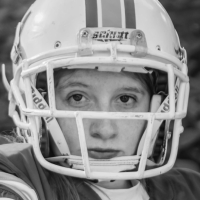
Millions watch football, but the players absorb thousands of hits no one can see. CTE is a degenerative brain disease caused by repeated head trauma and can only be confirmed through autopsy after death. A Boston University study found CTE in over 9 out of 10 former NFL players examined.

The evidence gap
- Medical Staff Primary user
No objective source of truth. Spotters flag injuries visually with no real-time data to justify a game-altering call. - Players Secondary user
Self-reporting fails by design. No protocol can fix a system where the patient controls the diagnosis.
Our North Star
How do we stop diagnosing CTE at autopsy and start detecting in life?
Process
Designing the missing system
Scoping to one sport
Our first instinct was to design a catch-all device. CTE shows up in soccer, gymnastics, boxing, and beyond, so why not build a universal wearable?
We quickly scratched that idea because breadth would cost us depth. Football is synonymous with CTE in the public imagination, and universal messaging would have diluted storytelling.
Placing the sensor
Forehead adhesive patch
Too wide application and sci-fi.
Wrist and limb wearables
Felt too indirect.
Integrated into the helmet
Localized to where the damage happens.
Choosing the primary user
We debated who the interface was even for. Players? Coaches? Family? We narrowed to medical staff: the only actor in the loop with both the authority to pull a player and no structural incentive to keep them in.

Structuring the interface
With the user and hardware defined, we designed a tri-view interface built around the questions medical staff need answers to in the moment:
Who needs attention?
Roster View
Full team at a glance, sorted by urgency.
What's happening?
Brain View
Region-level damage; progression over time.
What caused it?
Replay View
Tie every spike back to the play that caused it.
Figma Make's first pass at the Roster view listed every player at equal weight with no urgency signal. I led the redesign, surfacing the highest-risk player in a callout at top with the full roster below sorted by severity.

first AI pass of the Roster view
Final Product
NeuraLyfe: making the invisible visible
The two-part system: hardware that captures what's happening inside a player's brain, and an interface that turns that data into something medical staff can act on.
The Halo
The Halo is a multi-modal sensor wearable that integrates discreetly into existing helmets. We 3D-modeled it and printed a physical prototype to bring it to life.


EEG Sensors
Map brain activity and neural connectivity.
Biomarker Bands
Track p-Tau 217, NfL, and GFAP to form a CTE Progression Index.
Impact Camera
Verifies hits and reconstructs plays.
A note on the science: p-Tau 217, NfL, and GFAP are biomarkers individually linked to neurodegenerative disease in published research. The speculative part is combining them as a real-time CTE Progression Index.
The Interface
Roster view
Color-coded player cards and active player callout so CTE triage reads at a glance.
Brain view
A 3D brain with damage color-coded by region, and a season timeline to scrub through weeks and flag changes.
Replay view
Overlays severity, timestamp, and affected region onto game footage.
The Protocol
Without a decision rule, medical staff still carry the political weight of pulling a player. Our protocol is designed to make the call for them.
All data belongs to the player, travels with them across teams and into retirement, and removal alerts can't be suppressed.
Impact
First place.
NeuraLyfe won and took home the grand prize. Judges distinguished it for its visuals, video, storytelling, and especially prototype, which we 3D-printed to bring the concept to life.
690
Teams
2,184
Participants
$10,000
Grand prize

Reflections
Parallel prompting: polish vs. cohesion
Our breakthrough was splitting the interface into three flows and prompting Figma Make in parallel. This process gave us more refined outputs under a strict time-constraint, but it also cost us cohesion visually. Next time, I'd build a shared component library beforehand, instead of trying to retrofit consistency after.
Emotional resonance beats topical relevance
When producing our video, the hardest problem I faced was empathy. Football is niche and CTE is abstract, yet I had to get someone who's never watched a game to care about the cause. What I underestimated was that empathy travels further than interest, and being sport-specific widened emotional reach rather than narrow it.
our submission video
thanks for reading (✿・‿・)ノ゛
Up next
 Zendesk
 Digital Society Lab